1. Home
  2. Condos & Apartments
  3. Pumps

Pump repair & maintenance

Sump, circulation, booster and sanitary pumps.

The pumps in your mechanical room and pits keep water flowing to the top floor, heat moving through the building, and the lowest level dry. We repair them, maintain them, and replace them before they fail.

How they work together

The four pumps that keep your building running.

Pick a pump to follow its water through the building.

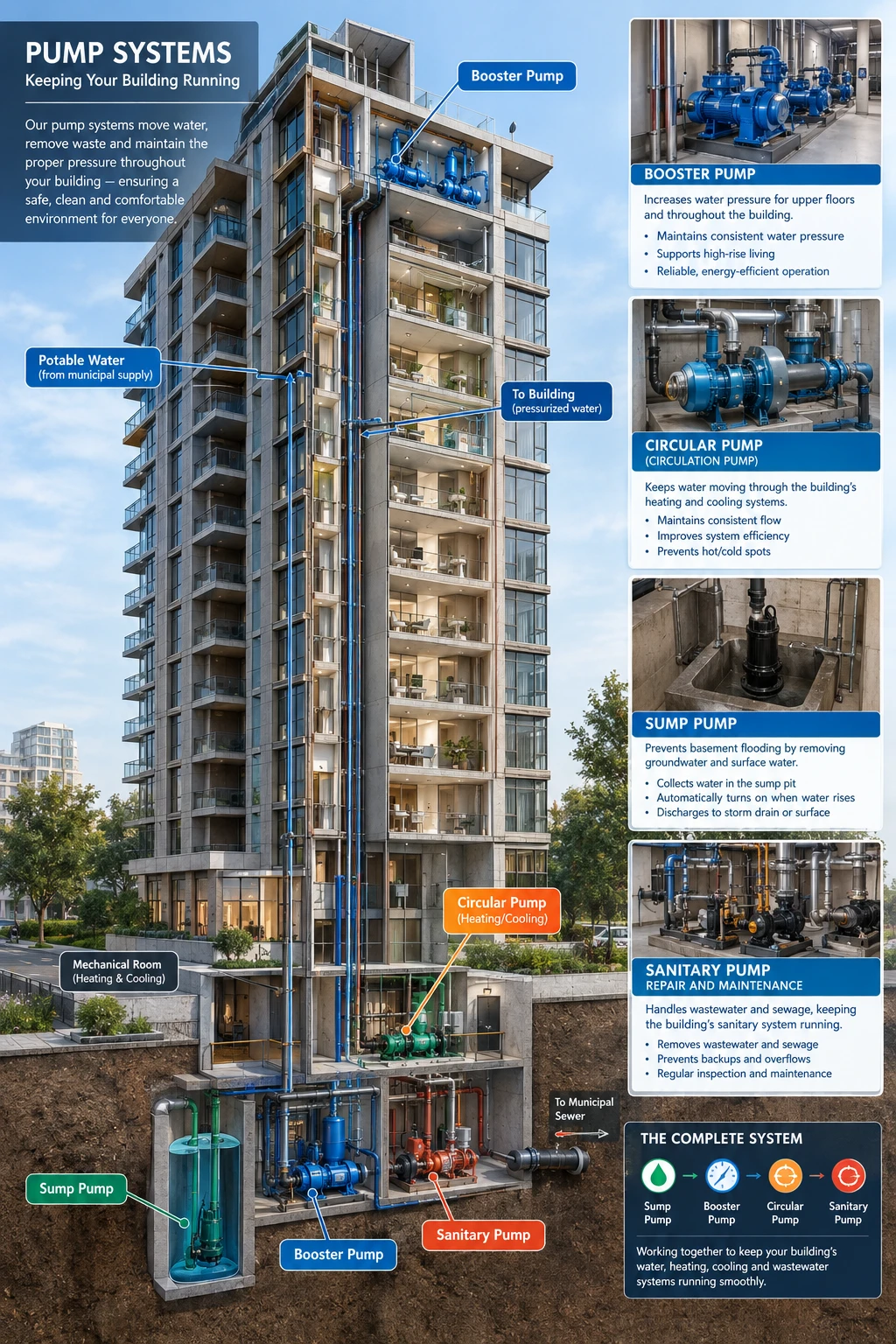
Pump systemsMoving water, heat and wastewater through a mid-rise building
Pump systems in a mid-rise apartment building Cut-away of a ten-storey apartment building. In the mechanical room, a booster pump takes water from the city main and pushes it up the cold-water riser to every floor, and a circulation pump moves heating water from the boiler up to the suites and back. Below the parking level, a sump pump empties groundwater from the foundation drains to the storm sewer, and a sanitary pump lifts wastewater from below-grade washrooms up to the building drain and the city sewer. The drain stack continues up through the roof as a vent. Mechanical room (P1) Parking (P2) City water main City sanitary sewer Storm sewer Foundation drain (weeping tile) Rooftop mechanical Roof vent Boiler 1 Booster pump 2 Circulation pump 3 Sump pump 4 Sanitary pump 1 2 3 4 Tap a number or a card

Raises the city water pressure so the upper floors get a strong, steady supply.

  • Keeps pressure even on every floor
  • Usually two or more pumps that take turns
  • We service drives, pressure sensors, valves and seals

Keeps hot water moving from the boiler through the heating and hot-water loops. Also called a circulator or "circular" pump.

  • Stops cold spots and long waits for hot water
  • Often runs around the clock, so bearings and seals wear
  • We replace pumps, motors, couplings and controls

Collects groundwater from the foundation drains in a pit and pumps it out before it floods the lowest level.

  • Turns on by itself when water rises in the pit
  • Sends water to the storm sewer or the surface
  • We test floats, alarms, check valves and backup pumps

Lifts wastewater from washrooms and drains below the sewer line up to the building drain.

  • Also called a sewage ejector or lift station
  • Usually a pair of pumps with a high-level alarm
  • We clear blockages, service floats and rebuild or replace pumps
The complete system

Four pumps working together to keep water, heat and wastewater moving, and the lowest level dry. When one fails, residents notice within hours.

  • Clean water
  • Heating water
  • Groundwater
  • Wastewater

Pump by pump

What each pump does, and the signs it needs attention.

Booster pumps

What does a booster pump do in an apartment building?

City water pressure drops as water climbs. In mid-rise and high-rise buildings, a booster pump system raises the pressure so the top floors get the same strong supply as the lower ones. Most systems use two or more pumps that take turns, controlled by a variable speed drive and pressure sensors.

Warning signs

  • Low pressure, or no water, on upper floors
  • Pressure that surges or drops at busy times
  • Pumps that run constantly or switch on and off rapidly
  • Alarms on the booster control panel

Circulation pumps

What does a circulation pump do?

Circulation pumps, also called circulator pumps, keep hot water moving through a building's heating loops and hot-water recirculation lines. Without them, suites far from the boiler get cold radiators and long waits for hot water.

Warning signs

  • Cold spots, or no heat, in some suites
  • Long waits for hot water on upper floors
  • Grinding or humming from the pump
  • Leaks around the pump seal

Sump pumps

What does a sump pump do in a building?

Foundation drains, also called weeping tiles, collect groundwater around the building and carry it to a sump pit in the lowest level. When the water rises, a float switch turns on the sump pump, which pushes the water out to the storm sewer or the surface. Elevator pits and parking garages often have their own sump pumps.

Warning signs

  • A high-water alarm sounding
  • Water on the lowest parking level or in the elevator pit
  • A pump that runs constantly, or not at all after rain
  • Rust, noise or a stuck float

Sanitary pumps

What does a sanitary pump do?

Washrooms, laundry rooms and floor drains below the street sewer cannot drain by gravity. A sanitary pump, also called a sewage ejector, collects their wastewater in a sealed pit and lifts it up to the building drain. Most buildings use a pair of pumps with a high-level alarm.

Warning signs

  • A sewage smell in the lower levels
  • Slow drains or backups in below-grade washrooms
  • A high-level alarm on the ejector panel
  • A pump that trips its breaker

Pump emergency? No water upstairs, water rising in the garage, no heat, or sewage backing up: call us right away.

Call (905) 604-3448

What we do

Repairs, replacements and the controls that run them.

Most pump failures start in the motor, the controls or the alarm. As electricians, we repair the whole system: the pump, its motor, its drive and its controls.

  • Emergency repairs and pump replacements
  • Motor, starter and variable speed drive (VFD) repairs
  • Float switch, high-water alarm and control panel repairs
  • Seal, bearing and impeller replacement
  • Check valve and isolation valve replacement
  • Backup pumps and battery or generator backup for critical pits
  • Preventive maintenance with a written report after each visit

Maintenance plan

A maintenance schedule that catches failures early.

A typical plan for a mid-rise building. We adjust it to your pumps, their age and how critical they are.

Monthly Quick checks

  • Test float switches and high-water alarms
  • Check that paired pumps take turns
  • Look and listen for leaks, noise and vibration
  • Check control panels for alarms and faults

Quarterly Electrical checks

  • Measure motor current and voltage
  • Inspect drives, starters and contactors
  • Check valves and pressure settings
  • Clear debris from sump and sanitary pits

Yearly Full service

  • Insulation test on pump motors
  • Inspect bearings, seals and couplings
  • Full system test, including backup pumps
  • Written report with photos and remaining-life notes for your reserve fund plan

Questions

Pump questions.

How often should building pumps be serviced?

Most building pumps should be checked monthly and fully serviced at least once a year. Sump and sanitary pumps only run when they are needed, so their floats and alarms should be tested regularly.

What is the difference between a sump pump and a sanitary pump?

A sump pump moves clean groundwater out of a pit to the storm sewer or the surface. A sanitary pump, or sewage ejector, moves wastewater from below-grade washrooms and drains up to the sanitary sewer. They use different pumps, pits and discharge lines.

Why do the upper floors lose water pressure?

Usually because the booster pump system is not keeping up: a failed pump, a faulty pressure sensor or drive, or a stuck valve. We test the system and repair or replace the part that failed.

Is a circular pump the same as a circulation pump?

Yes. Circular pump is a common name for a circulation pump, also called a circulator. It keeps hot water moving through heating and hot-water loops.

Should we repair or replace a failing pump?

It depends on the pump's age, the cost of parts and how critical it is. We give you both prices and a recommendation, so you can decide.

Still have a question? Ask us ›

Get started

Book a pump inspection before the next storm.

We'll check every pump, float and alarm, and tell you what needs attention first.

(905) 604-3448